

“Dividend growth is the true signal of a prospering company.”
– Lowell Miller (The Maxims of Wall Street, Page 183)
“A bear market can be your best friend if you’re reinvesting dividends.”
– Marc Lichtenfeld, Chief Income Strategist, The Oxford Club (Page 184)
If you are on Social Security (or soon will be), the truth is that your monthly Social Security check isn’t enough to live on. Far from it.
You probably need to double or triple your monthly Social Security income to live comfortably during these times of heightened inflation.
The Oxford Club to the rescue! In this column, I’ll show you an exciting new way to dramatically increase your monthly income through a unique new strategy that Wall Street has created in the past year or two.
Both Marc Lichtenfeld as the Senior Editor of The Oxford Income Letter and I as the editor of The Skousen Report emphasize the importance of supplementing your income by investing in companies that pay big (and rising) dividends.
First of all, I encourage all income earners to invest in stocks that have adopted a rising dividend policy. This chart shows why:
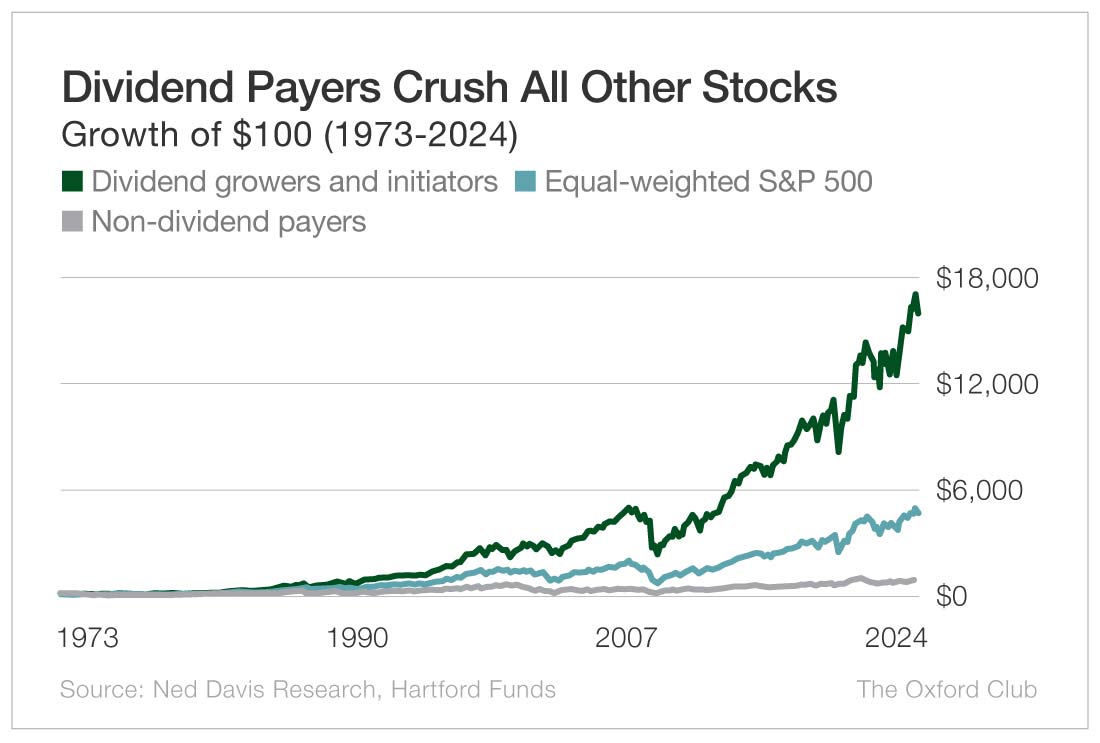 The evidence is overwhelming: Companies that have a rising dividend policy dramatically outperform the S&P 500 Index.
Limit your growth and income stocks to those that continue to raise their dividends, and avoid companies that cut or stop paying their dividends.
In my Skousen Report, I recommend a half-dozen investment companies that have 5% to 7% dividend yields and have raised their dividends for 10 years straight or more. They’ve consistently beaten the market.
Jeremy Siegel, the “Wizard of Wharton,” says it best in The Maxims of Wall Street (Page 183): “Dividends are the critical factor giving the edge to most winning stocks in the long run.”
I have a whole section in Maxims on the importance of income investing. Copies are available for only $22 each ($12 for additional copies) at Skousen Books at Discount. Marc Lichtenfeld and Chief Investment Strategist Alex Green are both quoted in the book, which is now in its 12th edition. Be sure to check out the dedication page. Get your copy today!
A New Strategy to Boost Your Monthly Income Even More
Now comes the fun part. In the past couple of years, fund managers, commercial banks, and private equity firms have created ETFs that use a covered call strategy to pay out double-digit monthly income on all kinds of stock indexes (and even gold and Bitcoin).
That’s right. You can earn 8% to 15% annualized monthly income from specialized ETFs.
Investors have been using covered call options to boost their income on stocks for decades, ever since the Chicago Board Options Exchange (CBOE) opened in 1973.
Covered calls are a way for conservative investors to earn more income on their favorite stocks. Marc recommends them from time to time on individual stocks.
Basically, the idea is that you sell a call option on a stock you own and capture the premium (on top of any dividends the company pays each quarter). It’s a conservative strategy because if the price of the stock goes up, you simply sell the shares to the buyer of the call option at the strike price. Both you and the call option buyer win.
If the stock goes down or moves up only slightly, you keep the stock, earn the dividend, and keep the premium.
Either way, you win.
The only downside is that if the stock skyrockets, you don’t enjoy the total gain from the stock appreciation.
Introducing Covered Call ETFs
The high-income ETFs make it even easier for conservative investors to make money on covered calls. Almost all of them have good liquidity in excess of a million shares traded daily.
For example, Neos Investments offers the NEOS Nasdaq-100 High Income ETF (Nasdaq: QQQI). It sells covered calls on the Nasdaq-100 and pays out around $0.60 per share every month for annualized monthly income of 13%. The ETF has risen 7% in price since inception in February 2024.
Neos also offers the NEOS S&P 500 High Income ETF (BATS: SPYI). Using covered calls on the S&P 500 Index, it pays out a monthly dividend of around $0.52 per share, or a 12% annualized return. It has risen 4% since inception in September 2022.
Goldman Sachs and JPMorgan Chase have gotten into the act as well. The Goldman Sachs S&P 500 Premium Income ETF (Nasdaq: GPIX) pays out a monthly dividend of around $0.37 a share, amounting to an 8% annualized return. It has returned 36% in capital gains since inception in October 2023. JPMorgan Chase offers covered call options in the JPMorgan Nasdaq Equity Premium Income ETF (Nasdaq: JEPQ). Its monthly payouts vary more, from $0.44 to $0.55 per share, for an annualized yield of 10.5%. It’s also seen a price gain of 18% since inception in May 2022.
High-Income Gold and Bitcoin ETFs With Weekly Dividends!
One of the most interesting covered call income ETFs is the YieldMax Gold Miners Option Income Strategy ETF (NYSE: GDXY). In the past year, it has paid out 35 dividends amounting to $9.26, or a 67.5% annual dividend yield! (Since shifting to a weekly dividend policy in October, it has paid 29 weekly dividends in a row.)
It achieves this return by using a covered call strategy on the VanEck Gold Miners ETF (NYSE: GDX). Now, it suffered a 13% capital loss over the past year using this strategy, but on a net return, the ETF made a profit of around 59%. If you had invested in the VanEck ETF alone, you would have made 90%.
YieldMax even has a covered call ETF for Bitcoin, the YieldMax Bitcoin Option Income Strategy ETF (NYSE: YBIT). It’s not as liquid, but it still paid out more in weekly distributions than the price of the ETF. The 100% gain in dividends was offset by a decline of 53% in the price of the ETF!
The Best High-Income ETF
So far, the best-performing ETF is the Goldman Sachs Nasdaq-100 Premium Income ETF (NYSE: GPIQ). It pays around $0.44 per share each month for an annualized yield of 10%. The ETF has advanced an outstanding 40% since inception in October 2023, giving it an annualized return of 24%.
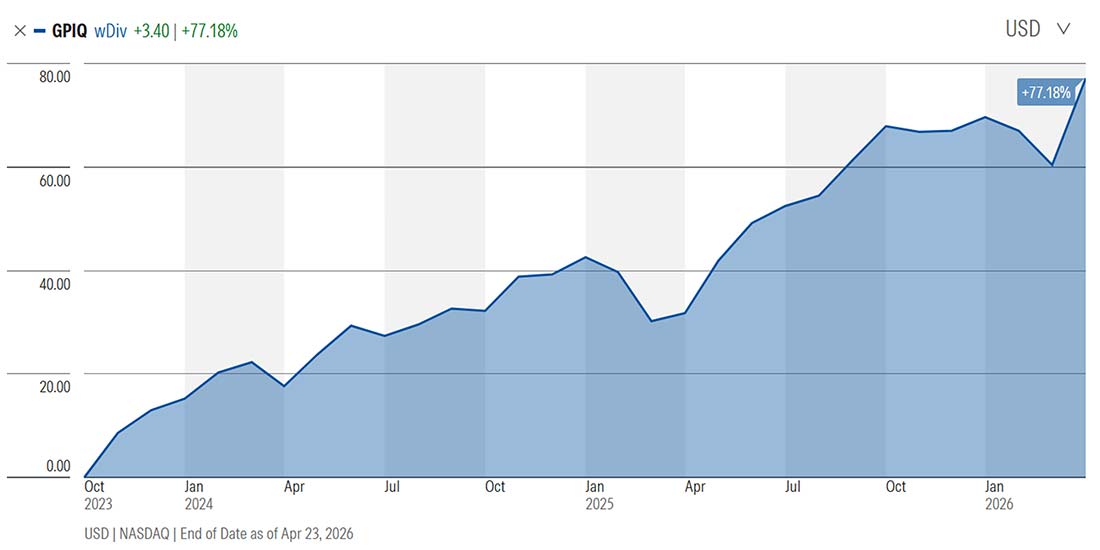 Of course, if you had invested directly in the Nasdaq-100 (QQQ) since October 2023, the total return would be 90%. Investing in GPIQ would have generated a total return, including dividends, of 77%.
In sum, the covered call option strategy through these specialized ETFs offers convenient high monthly income and less risk, but the cost for writing covered call options and earning monthly income is a somewhat lower total return. There’s always a trade-off.
— Mark Skousen
Top Stock Expert Who Called Nvidia at Less Than a Dollar Says... "$1,000 in Each of These Stocks Could Make You a Millionaire" By 2030.
Source: Wealthy Retirement
