

Oracle (ORCL) just had another big day. Shares gained about 5.0% yesterday to close at $178.34, extending a blistering four-day run of roughly 29%. That’s the kind of move that gets Wall Street’s attention fast. And from a technical standpoint, which we’ll get to in a second, the stock’s rally may still have legs.
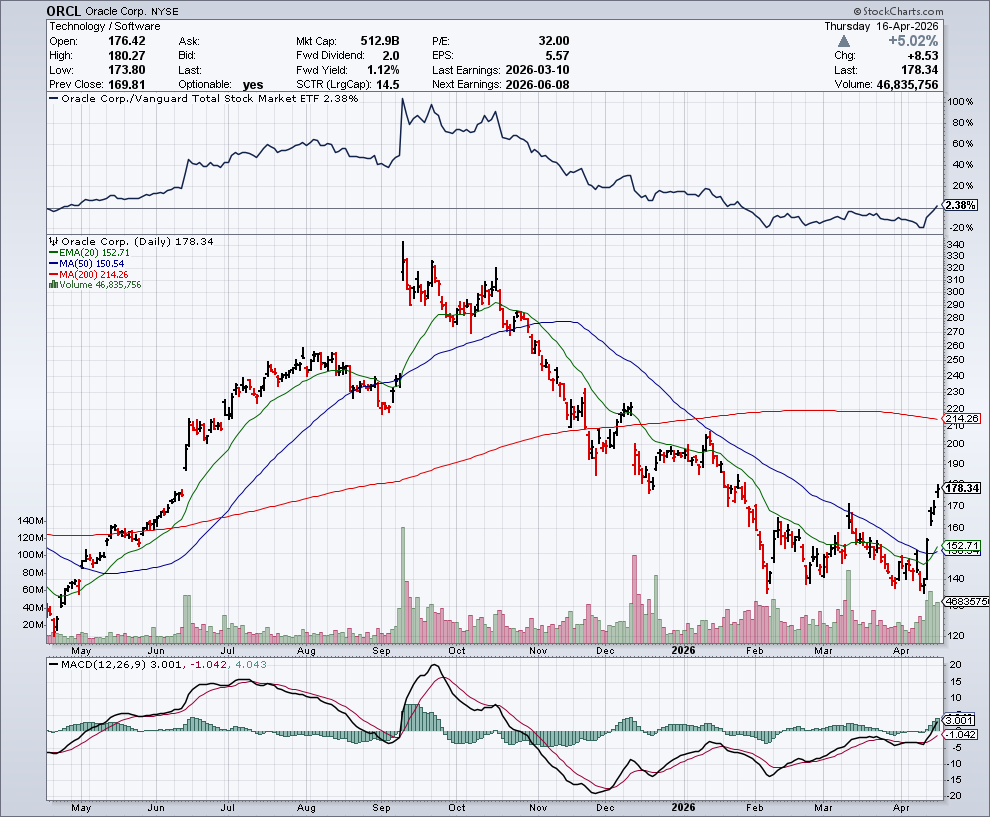
Oracle is no longer just the old-school database and enterprise software giant most investors think they know. More and more, the market is starting to treat it as an AI training and sovereign infrastructure story — and that shift is a big reason the stock has been attracting fresh attention.
In plain English, Oracle still sells the software large enterprises rely on, but the part of the story moving fastest right now is Oracle Cloud Infrastructure (OCI). That business has become one of the company’s biggest growth engines as demand for AI computing capacity keeps rising.
Here’s what’s going on…
The Catalysts Behind the Breakout
The immediate driver behind yesterday’s move was Oracle’s new collaboration with Amazon Web Services (AWS) to expand multicloud networking. The deal allows customers to establish private, high-speed connectivity between OCI and AWS, which matters because it positions Oracle less as a pure AWS rival and more as a complementary cloud layer. In other words, this expands Oracle’s addressable market instead of forcing it into a winner-take-all fight.
And that announcement didn’t land in a vacuum. Oracle had already been building momentum after announcing a strategic partnership with DENSO to deploy Oracle Fusion Cloud and launch an AI Center of Excellence focused on supply-chain modernization. Before that, the stock had already surged sharply as software and infrastructure names rebounded and investors rotated back into high-quality AI-linked stories.
This move didn’t come out of nowhere. Oracle has been stacking catalysts over several sessions, and the stock has responded in kind.
| Date | Catalyst / Context | Close | Daily Move |
|---|---|---|---|
| Apr 10 | Baseline / recent low | $138.09 | — |
| Apr 13 | Broad market recovery + sector rotation into software / AI infrastructure | $155.62 | +12.7% |
| Apr 14 | Follow-through buying as momentum builds | $163.00 | +4.7% |
| Apr 15 | DENSO partnership + AI Center of Excellence announcement adds fuel | $169.81 | +4.2% |
| Apr 16 | AWS multicloud networking collaboration announced | $178.34 | +5.0% |
If needed, swipe or scroll sideways to view the full table.
That adds up to a gain of 29.1%, from $138.09 on April 10 to $178.34 on April 16. In other words, Oracle hasn’t just bounced — it has been steadily building momentum as the AI infrastructure story keeps getting stronger.
The broader reason Oracle has become more interesting is that it now sits squarely in the middle of one of the market’s hottest themes: the race to build enough infrastructure to support AI training and inference.
OCI has been growing at a blistering pace, with recent cloud infrastructure revenue up more than 80%. That matters because investors are no longer looking at Oracle as just a legacy software company — they’re starting to view it as a serious player in the GPU cloud and AI capacity buildout.
The company’s role in the massive OpenAI Stargate project only reinforces that story. Oracle is positioned as a major infrastructure partner, which gives the market another reason to believe the company could be tied to a very large, long-duration stream of AI-related demand.
And this isn’t just a story stock riding hype. In its March report, Oracle posted an earnings beat of roughly 15%, coming in at about $1.79 per share versus expectations of $1.55. That was an important signal because it suggested the company is starting to back up the AI narrative with real execution.
There’s also a long-term visibility angle here that investors clearly like. Oracle is sitting on an enormous $553 billion Remaining Performance Obligations backlog, which gives the market a huge pool of future contracted demand to focus on. In other words, investors are not just betting on vague AI excitement — they’re looking at a company with a massive queue of business already lined up.
Another piece of the story is power. Oracle recently expanded its partnership with Bloom Energy to support fuel-cell capacity for data centers, which matters because one of the biggest bottlenecks in AI infrastructure right now is simply getting enough power online fast enough. If Oracle can solve that problem better than peers, the market will likely continue rewarding the stock.
Wall Street’s broader view has also remained constructive. While several firms cut price targets back in March, the ratings themselves stayed overwhelmingly bullish — and a number of analysts still see meaningful upside from current levels.
Analyst Momentum
| Date | Firm | Action | Price Target | Implied Upside / Downside |
|---|---|---|---|---|
| 07 Apr 2026 | Stephens & Co. | Confirms Hold | $254 | +42.4% |
| 24 Mar 2026 | Bank of America | Confirms Buy | $200 | +12.1% |
| 16 Mar 2026 | Mizuho | Confirms Buy | $320 | +79.4% |
| 13 Mar 2026 | Guggenheim | Confirms Buy | $400 | +124.3% |
| 12 Mar 2026 | Citigroup | Confirms Buy | $320 | +79.4% |
| 11 Mar 2026 | JP Morgan | Upgrades to Buy | $210 | +17.8% |
| 11 Mar 2026 | Cantor Fitzgerald | Confirms Buy | $229 | +28.4% |
| 11 Mar 2026 | Barclays | Confirms Buy | $240 | +34.6% |
| 11 Mar 2026 | D.A. Davidson | Confirms Buy | $200 | +12.1% |
| 04 Mar 2026 | RBC Capital | Confirms Hold | $160 | -10.3% |
| 25 Feb 2026 | Oppenheimer | Upgrades to Buy | $185 | +3.7% |
If needed, swipe or scroll sideways to view the full table. Implied upside / downside is based on a current stock price of $178.34.
The bigger picture is still constructive: 24 of the 29 ratings in this period were Buys, only 4 were Holds, and there were no Sells. In other words, even after a wave of target cuts in March, Wall Street never really turned bearish on Oracle — it just reset expectations before leaning bullish again.
Put it all together, and Oracle is starting to look less like a traditional enterprise software name and more like an AI infrastructure play with real scale, real demand, and a story the market is increasingly willing to pay up for.
Of course, this is not a risk-free setup. Oracle still has to convert that enormous backlog into real profitable growth, and any slowdown in data-center buildouts or broader weakness in tech could create volatility along the way.
Still, right now the combination of OCI hypergrowth, a fresh AWS multicloud catalyst, major AI infrastructure tailwinds, an earnings beat, and a bullish technical breakout makes ORCL one of the more interesting setups on the board.
The headlines may have helped light the fire, but the chart is what could determine whether this move has real staying power. Here are the bullish technical signals traders should be watching now.
Bullish Technical Signals
#1 Downtrend Channel Breakout: Over the past few weeks, the stock had been stuck inside a downtrend channel, marked by the purple lines on the daily chart. Now it has broken out above that range — and that’s often the kind of move that can signal a change in character. Once a stock pushes through the upper rail of a downtrend channel, it can open the door to a stronger move higher.
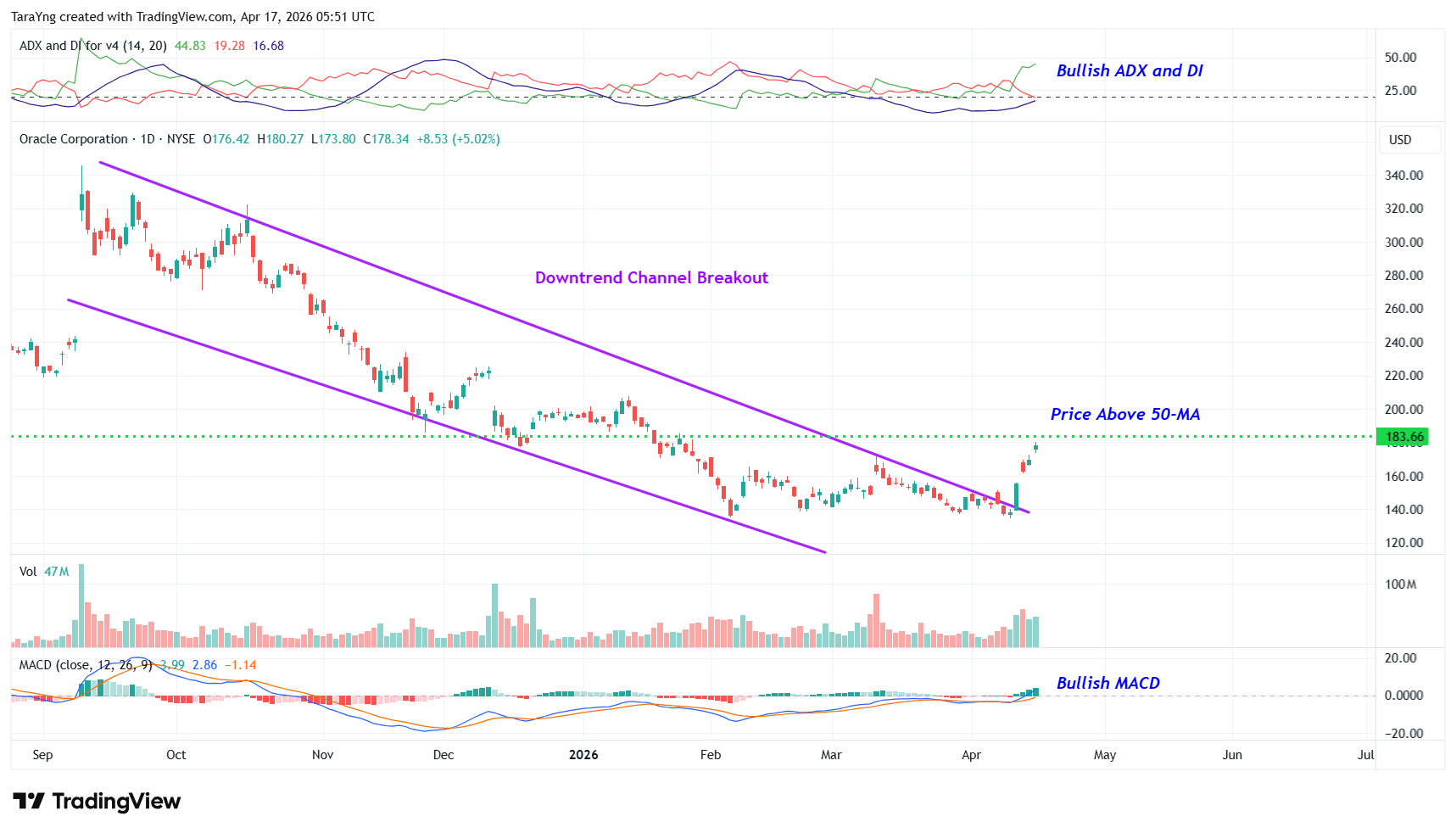
ORCL – Daily Chart
#2 Price above MA: The stock is also trading above its 50-day moving average, which is another sign that the bulls are starting to take control. That’s exactly where you want to see it if momentum is beginning to build.
#3 MACD Above Signal Line: Momentum is leaning bullish too. On the daily chart, the MACD line is sitting above the signal line, which is usually a sign that upside momentum is starting to build rather than fade.
#4 Bullish ADX: The trend-strength picture looks constructive as well. The +DI line is still above the –DI line, and the ADX line has started to turn higher — a sign that bullish momentum may be building rather than fading.
#5 Above Support Area: The weekly chart is telling a bullish story too. The stock has pushed higher from a former resistance level that now appears to be acting as support, marked by the pink dotted line. That kind of flip is exactly what bulls want to see, because it suggests the stock may be building a solid base for another move higher. Add in the fact that shares are still trading above the 200-week moving average, and the bigger-picture trend still looks supportive.
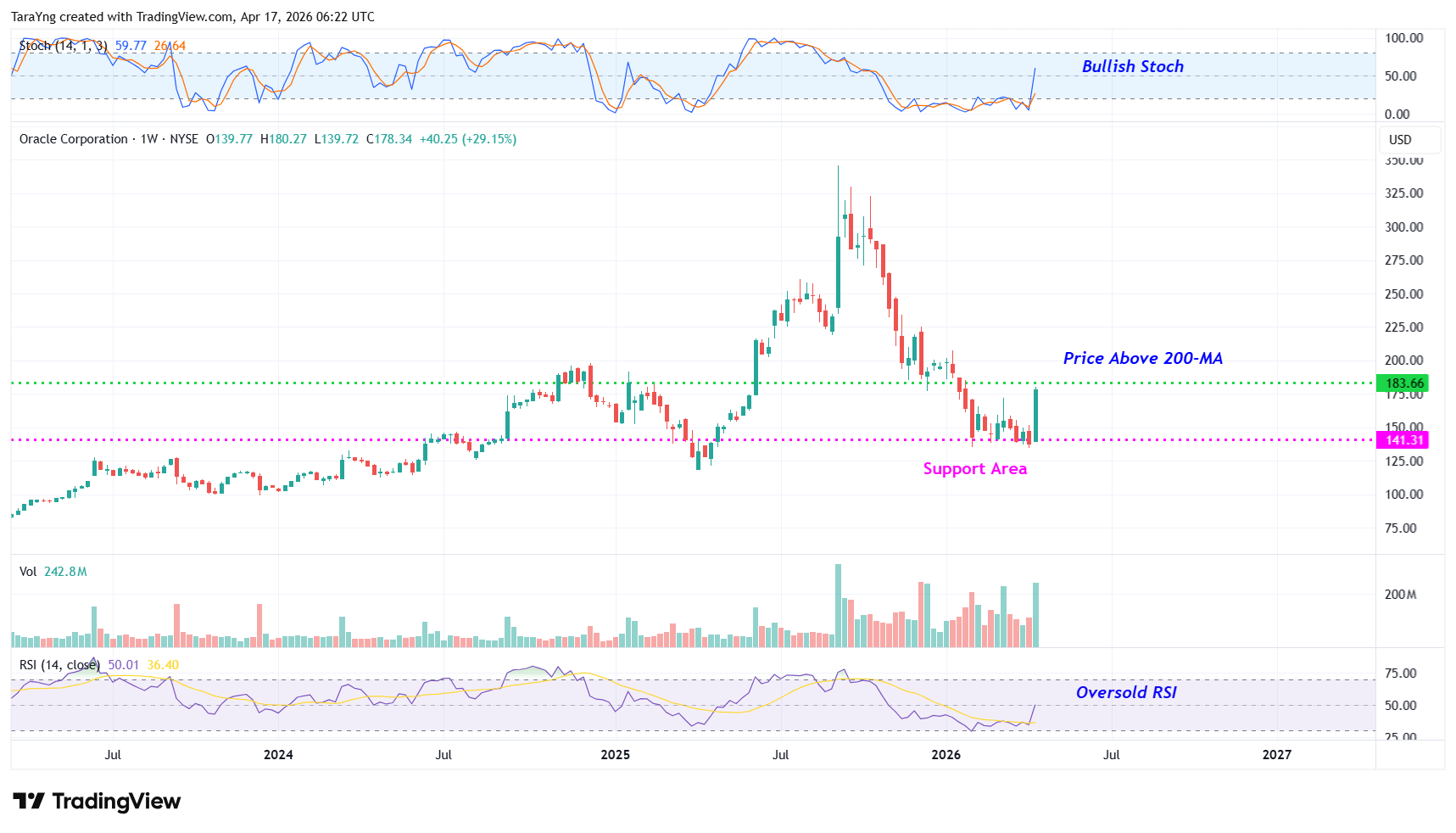
ORCL – Weekly Chart
#6 %K above %D: Momentum may be starting to turn higher on the weekly chart as well. The %K line of the stochastic indicator has crossed above the %D line and is pushing higher from oversold territory — often an early sign that the bulls are starting to regain control.
#7 Oversold RSI: The weekly RSI is also starting to turn up from oversold territory, which suggests momentum may be shifting back in the bulls’ favor. That’s often the kind of early signal traders want to see when a stock is trying to build on a breakout.
Recommended Trade Setup
| Item | Detail |
|---|---|
| Buy Level | Above approximately $183.70 |
| Price Target 1 | $208.00 Potential upside: 13% |
| Price Target 2 | $222.00 Potential upside: 21% |
| Timeframe | Next 3–6 months |
| Stop-Loss | $171.00 on a closing basis |
If needed, swipe or scroll sideways to view the full table.
For a risk of approximately $12.70 per share, the target rewards are about $24.30 and $38.30 per share. That makes this roughly a 1:2 and 1:3 risk-reward trade. In other words, the setup offers nearly 2x to 3x more potential upside than downside.
Risks to Consider
Even strong setups can fail, especially after a move this sharp. A few things could knock ORCL off course:
- A breakdown back below the trend channel on heavy volume
- Negative company-specific news or weaker-than-expected execution
- Broad market weakness that drags down tech and AI infrastructure stocks
- Renewed U.S. tariff pressures or fresh geopolitical tensions in the Middle East that push investors into a more defensive posture
- Any slowdown or delay in data-center construction, which could directly impact Oracle’s ability to keep up with AI-related demand
- The simple fact that converting a $553 billion RPO backlog into real profitable growth takes a tremendous amount of operational execution
Happy Trading!
Tara and Greg
