

With the two-week U.S.-Iran ceasefire announced April 8 already fraying, investors confront real uncertainty. Israel keeps striking targets in Lebanon, Iran still controls the Strait of Hormuz and is demanding tolls for safe tanker passage, and President Trump warned on Truth Social that Iran must honor the terms or “the Shootin’ Starts.”
Oil reacted in real time. It plummeted 17% the day after the announcement, but crude is now climbing back toward $100 a barrel as tensions mount.
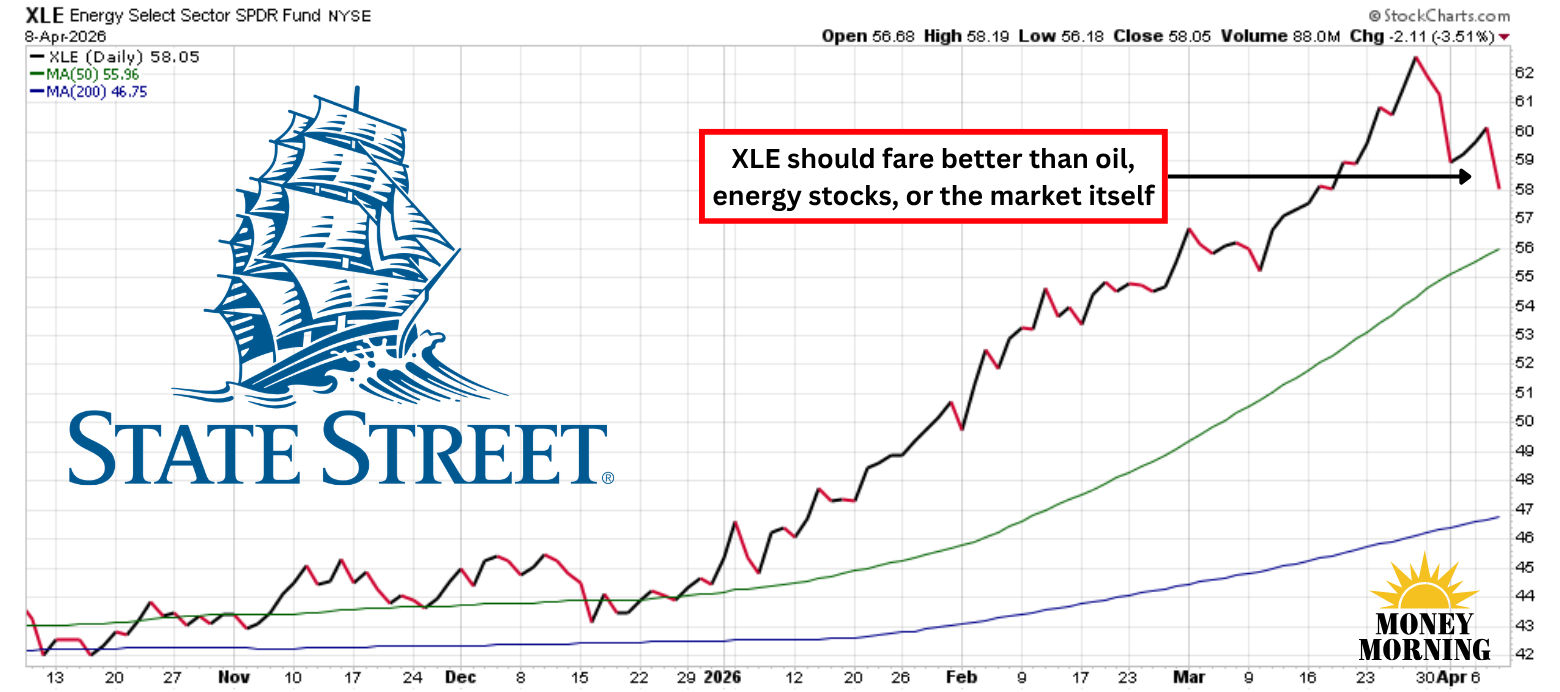
How do you navigate this without picking sides on geopolitics? The clearest answer sits in the Energy Select Sector SPDR ETF (XLE).
The Integrated Oil Advantage
Let’s cut to what matters. Integrated oil companies produce crude upstream and refine it downstream into gasoline, diesel, and chemicals. Higher prices boost upstream revenue and cash flow. Lower prices cut feedstock costs and expand refining margins.
That’s a fancy way of saying these firms profit regardless of oil’s direction. ExxonMobil (XOM) and Chevron (CVX) together account for 40.55% of XLE.
ExxonMobil generated $52 billion in cash flow from operations for full-year 2025. Chevron recorded $13.2 billion in levered free cash flow over the trailing 12 months. These numbers illustrate the built-in buffer that pure upstream or downstream players lack.
 XOM and CVX Stack Up Strong on Key Metrics
Here’s how the two leaders compare on numbers that drive returns:
 XOM trades at a lower valuation multiple while CVX delivers higher income. Both generate durable cash flow that funds dividends and buybacks whether crude tops $100 or dips below $90.
XLE’s Built-In Buffer Delivers in Turbulent Markets
XLE itself declined just 3.5% during the April 8 oil sell-off – less than the sharper drops seen in many individual upstream stocks. The fund is rising once again as tensions mount and prices rebound.
It charges a 0.08% gross expense ratio, keeping costs minimal compared with many sector funds that run 0.50% or higher.
Granted, no outcome is guaranteed. Yet XLE’s heavy tilt toward integrated majors means it captures oil-price upside while its refining exposure cushions any pullback if the truce somehow holds.
A Track Record Built for Energy’s Cycles
Let’s check the numbers. The ETF delivered a 35.29% return over the past year on a NAV basis. It annualized 17.70% over three years and 24.59% over five years. Since its inception on Dec. 16, 1998, XLE has returned 9% annualized. These figures show the fund has rewarded patient investors through multiple oil-price swings – precisely the resilience that matters when geopolitics keep markets on edge.
Bottom Line
In short, XLE turns today’s Iran-related uncertainty into a practical edge for retail investors. It delivers balanced exposure to cash-flow powerhouses at rock-bottom cost. The ETF is worth adding to your portfolio, with more aggressive accumulation if the price falls, so long as it matches your risk tolerance. Then keep an eye on the Strait of Hormuz – and Trump updates on social media.
— Rich Duprey
Carnegie didn't invent steel. He used new technology to produce it cheaper and faster than anyone on Earth. Rockefeller didn't discover oil. He used industrial machinery to refine it more efficiently. Vanderbilt didn't build the railroad. He understood that whoever controlled the infrastructure controlled the economy. Their combined fortunes were between $700 billion and $1 trillion. Best-selling financial author Alexander Green has identified three companies positioned to be the Titans of the AI age. CLICK HERE TO FIND OUT WHO THEY BEFORE THE WINDOW CLOSES.
Source: Money Morning
