

Very soon, your smartphone, car, factory robots, and even home appliances will all talk to each other in real time, powered by always-on AI that senses, computes, and connects without a hitch. That’s hyper-connectivity – and it’s not some far-off sci-fi dream. It’s arriving now through 5G-Advanced rollouts and the first steps toward 6G.
While investors chase the latest GPU headlines, the wireless infrastructure enabling it all has flown under the radar. Qualcomm (QCOM) is already crushing this shift. Let’s break down why it matters for your portfolio.
The Hyper-Connectivity Wave No One Is Discussing
5G-Advanced (3GPP Release 18 and 19) adds AI-native features, precise sensing, and massive device scaling. Early 6G prototypes promise device-to-data-center integration with power-efficient connectivity.
Qualcomm laid the groundwork in March by announcing the X105 5G Modem-RF – the world’s first Release 19-ready modem – and deepened its T-Mobile (TMUS) partnership to hit commercial 6G systems by 2029. The company also completed its Alphawave Semi acquisition to accelerate high-speed wired connectivity into data centers. In short, Qualcomm is turning hyper-connectivity from buzzword to reality across IoT, automotive, and industrial networks.
 Qualcomm’s Numbers Show It’s Winning
Qualcomm delivered record results in its fiscal first quarter. Total revenue hit $12.3 billion, up 5% year-over-year from $11.7 billion. The QCT semiconductor segment – where the wireless magic happens – reached a record $10.6 billion, also up 5%.
Here’s how it breaks down by the hyper-connectivity drivers:
- IoT revenue: $1.69 billion, up 9% – fueled by networking and consumer devices that thrive on dense, always-connected networks.
- Automotive revenue: $1.10 billion, up 15% for the second straight quarter above $1 billion, as carmakers adopt Snapdragon Digital Chassis for connected cockpits.
- Handset revenue: $7.82 billion, up 3%, even amid temporary memory supply constraints.
Licensing (QTL) added $1.59 billion, up 4%, with EBT margins expanding to 77% from 75%. That’s the high-margin engine funding R&D into 6G. Compare that to peers: Qualcomm holds roughly 70% share in discrete 5G basebands and over 60% in premium Android application processors, while MediaTek pressures the mid-range on price but lags in flagship AI and modem leadership. Broadcom (AVGO) competes in some networking chips but lacks Qualcomm’s end-to-end modem-to-antenna stack for mobile and IoT.
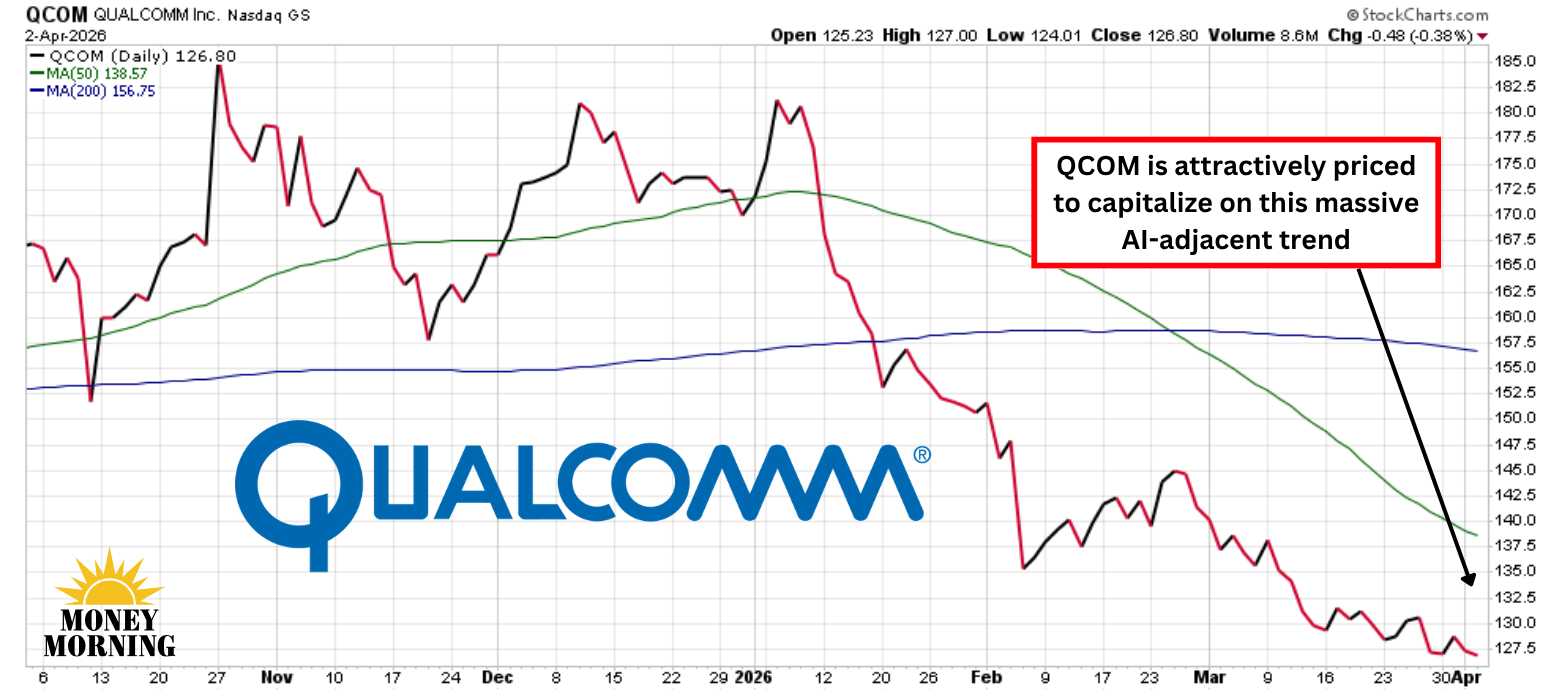
Valuation remains reasonable. Shares trade at a trailing P/E of 26.2x with a 2.8% dividend yield ($3.56 annualized). The company returned $3.6 billion to shareholders in the quarter alone – including $2.6 billion in repurchases. Trailing free cash flow margins sit at a healthy 28.8%, giving it flexibility even as handset builds pause temporarily.
Risks Investors Should Note
Of course, near-term handset softness from industry-wide memory constraints led to Q2 guidance of $10.2 billion to $11 billion in revenue, below some expectations. That said, IoT and automotive are accelerating – projected low-teens and 35%+ growth, respectively – and management remains on track for its fiscal 2029 revenue targets.
Bottom Line
When all is said and done, Qualcomm is positioned to dominate the hyper-connectivity boom that 5G-Advanced and early 6G will unleash. With diversified growth, a rock-solid balance sheet, and a reasonable 26.2x P/E plus 2.8% yield, it offers retail investors a data-backed way to own the wireless picks-and-shovels play everyone else is overlooking. Consider adding shares on any near-term dips – the long-term setup is too compelling to ignore.
— Rich Duprey
Rumors are spreading quickly... Elon is gearing up to buy a tiny, publicly traded company. Why? Because it holds the exclusive rights to a $16 trillion MOTHERLODE of the exact materials his empire runs on... rare metals like cobalt, manganese and lithium. On January 1st, a new Pentagon rule cuts off his Chinese supply. Today, it's a $5 stock... but once Elon makes his move, it could soar to $50 within 6 months. Click here for the full story.
Source: Money Morning
