

The last few weeks of elevated volatility in the markets has reminded me that some things never change.
One of those things that never changes is myopia among market participants.
It’s a shortcoming that seems to be part of human nature, striking generation after generation.
Most people simply cannot avoid focusing on the short term.
I see people on social media flaunting stock charts over the last month or two and using these to try to prove something about the underlying businesses – when all it does is prove that these people are succumbing to the same shortsighted, short-term behavioral biases that can cost a lot of money.
Now is a time where you double down and make sure you’ve hitched your wagon to long-term business results, not short-term stock movements.
This is why I’m such a fan and personal practitioner of dividend growth investing.
This long-term investment strategy, which advocates buying and holding shares in world-class businesses paying steadily rising cash dividends, almost automatically filters out short-term thinking.
The Dividend Champions, Contenders, and Challengers list has compiled invaluable information on hundreds of the world-class businesses that qualify for this strategy.
As you can see, many of these businesses have decades of consistent dividend growth already achieved.
 What’s a month or two of price changes against that?
If you’re spending years of your life building a portfolio full of great businesses designed to one day generate enough dividend income for you to live off of, daily stock movements are almost meaningless in the grand scheme of things.
I speak from experience, as I’ve spent the last 15+ years building the FIRE Fund.
That’s my real-money portfolio, and it produces enough five-figure passive dividend income for me to live off of.
I’ve actually been able to live off of this since I quit my job and retired in my early 30s.
If you’re curious as to how that happened, make sure to read my Early Retirement Blueprint (which shares how you can do it, too).
 Much of my success has resulted from not just investing in the right businesses, but also investing at the right valuations.
Price only represents what you pay, but value represents what you get.
An undervalued dividend growth stock should provide a higher yield, greater long-term total return potential, and reduced risk.
This is relative to what the same stock might otherwise provide if it were fairly valued or overvalued.
Price and yield are inversely correlated. All else equal, a lower price will result in a higher yield.
That higher yield correlates to greater long-term total return potential.
This is because total return is simply the total income earned from an investment – capital gain plus investment income – over a period of time.
Prospective investment income is boosted by the higher yield.
But capital gain is also given a possible boost via the “upside” between a lower price paid and higher estimated intrinsic value.
And that’s on top of whatever capital gain would ordinarily come about as a quality company naturally becomes worth more over time.
 These dynamics should reduce risk.
Undervaluation introduces a margin of safety.
This is a “buffer” that protects the investor against unforeseen issues that could detrimentally lessen a company’s fair value.
It’s protection against the possible downside.
Anchoring to the long term and steadily acquiring undervalued high-quality dividend growth stocks (which, by the way, is even easier during times of elevated volatility) is a fantastic way to not only attain but sustain financial independence.
Now, the preceding does assume a basic understanding of valuation is already in place.
If that’s not the case for you, this is where Lesson 11: Valuation comes in.
Written by fellow contributor Dave Van Knapp, it delivers a great overview of what valuation is and how to apply it so that you can make intelligent investment decisions.
With all of this in mind, let’s take a look at a high-quality dividend growth stock that appears to be undervalued right now…
 Danaher Corp. (DHR)
Danaher Corp. (DHR) is an American healthcare company which manufactures and markets products used for advances in biotechnology, life sciences, and diagnostics.
Founded in 1969, Danaher is now a $128 billion (by market cap) life sciences juggernaut that employs 59,000 people.
About 40% of sales are derived from the US, with the remainder occurring from outside the US.
The company reports results across three segments: Diagnostics, 40% of FY 2025 revenue; Biotechnology, 30%; and Life Sciences, 30%.
Under stewardship of the billionaire Rales brothers (who still combine to own more than 10% of the company), Danaher has employed the serial acquirer model and the Danaher Business System (a kaizen-based business culture of continuous incremental improvement of processes designed to drive growth, innovation, and efficiency) to build one of the world’s largest healthcare companies and a masterclass in execution.
This stock is up more than 80,000% since 1986 – and that’s before accounting for all of the various spinoffs which have also occurred during that period, as well as dividends received by shareholders – making this one of the best long-term investments to ever exist.
Danaher owns a range of businesses across healthcare ecosystems, and these businesses often manufacture high-precision, high-value products used for activities (such as molecular biology) where exactness is required.
Danaher’s scale, reputation, and expertise are invaluable on this front, making it a go-to firm for laboratories.
There are very high barriers to entry here, as nobody is recreating a Danaher on their computer or in their garage.
Plus, many of the products it manufactures use consumable components, leading to a high degree of recurring and visible revenue for Danaher.
With the world growing larger, older, and wealthier, and with healthcare companies around the world outlaying plenty of capital on R&D as they race for treatments and cures, demand for and spending on the healthcare tools Danaher provides is highly likely to rise for many years to come.
And that positions the company to continue increasing its revenue, profit, and dividend.
Dividend Growth, Growth Rate, Payout Ratio and Yield
Indeed, Danaher has increased its dividend for 13 consecutive years.
And its dividend growth has been nothing short of spectacular.
 Its 10-year dividend growth rate is 14.3%.
But get this: Dividend growth is accelerating.
Its most recent dividend raise came in at an astounding 25%!
This is indicative of quality, growth, and a willingness to share the success with shareholders.
I love all of that.
Now, the trade-off (as per usual) for all of that dividend growth is the yield.
That’s to be expected.
The stock’s yield is only 0.9% right now, which isn’t great, but it is 50 basis points higher than its own five-year average.
The market has been willing to accept a very low yield from this stock (partly out of a function of the market bidding the stock price up, driving the yield down), but that deal isn’t so hard to accept now.
A 1%ish yield might not work for retirees, but those who are younger and more concerned with long-term performance and returns are likely going to focus much more on that mid-teens dividend growth and what that implies for the total return (of which is only partially comprised of a dividend).
With a payout ratio of 31.7%, Danaher’s dividend remains highly secure with plenty of headroom for more huge increases ahead.
For younger dividend growth investors predisposed to high-quality compounders, Danaher is clearly shaping up to be appealing.
Revenue and Earnings Growth
As much as that may be the case, though, a lot of this appeal is formulated using past information.
However, investors must always be thinking about possible future information, as today’s capital is risked for tomorrow’s rewards.
As such, I’ll now build out a forward-looking growth trajectory for the business, which will be of great use when the time comes later to estimate fair value.
I’ll first show you what the business has done over the last ten years in terms of its top-line and bottom-line growth.
I’ll then reveal a professional prognostication for near-term profit growth.
Blending the proven past with a future forecast in this manner should allow us to roughly gauge where the business might be going from here.
Danaher moved its revenue from $16.9 billion in FY 2016 to $24.6 billion in FY 2025, which is a compound annual growth rate of 4.3%.
While this might seem rather unimpressive (and it is), especially for a company of Danaher’s stature and reputation, there’s context behind this.
Danaher has executed a number of large spin-offs over the last decade, with Fortive Corp. (FTV) (spun out in 2016) and Veralto Corp. (VLTO) (spun out in 2023) – combining for $38 billion in market cap together – being particularly notable.
Danaher is seeding new money machines across the market, so its comprehensive grandness as an enterprise has to incorporate all of that.
Meanwhile, earnings per share grew from $3.65 to $5.05 over this period, which is a CAGR of 3.7%.
Not excellent at all.
Certainly not befitting of a preeminent healthcare company.
Again, though, it’s important to keep in mind that the last decade included massive spin-offs, and there’s also been a severe post-pandemic hangover after a temporary pull-forward in sales caused a huge spike in sales during 2021 and 2022 – which Danaher is still recovering from as it normalizes its revenue and profit base.
A lot of moving parts here, and I don’t think this decade accurately depicts Danaher’s true growth profile.
Notably, Danaher shareholders who held everything throughout this time frame have shares in numerous other terrific businesses, so there’s lots to like about the whole picture.
Looking forward, CFRA believes that Danaher will compound its EPS at an annual rate of 10% over the next three years.
That’s likely closer to what Danaher is truly capable of at full power, although even this might be selling Danaher a bit short.
After a tumultuous period which included large spin-offs, extensive portfolio transformation, and a global pandemic, CFRA sees Danaher as a life sciences pure-play set to take advantage of rising demand in high-growth markets, accelerate growth, and expand margins.
The last decade has been tough, likely causing those newer to the Danaher story wondering what’s so great about this business and why it’s been such a monster investment for decades.
Near-term criticism is fair, although the spin-offs have been material, but Danaher is now in “show-me” mode and must return to its prior glory as a double-digit grower.
Notably, after the spin-offs, the company has concentrated itself into an elite R&D product specialist, so it’s not the more diversified Danaher of the past, and this means it’s more subjected to the forces of a single industry with a smaller pool of acquisition targets.
With a 10% bottom-line forecast in play – one I’m inclined to side with – that creates fertile ground for Danaher to continue growing the dividend at double-digit rates for the foreseeable future.
Combining that with the ~1% yield frames up a LDD type of annualized total return from here – before any kind of multiple expansion back to historical norms as Danaher restores its legacy.
That’s pretty compelling for those who favor total return (since the yield isn’t much to write home about).
Financial Position
Moving over to the balance sheet, Danaher has a strong financial position.
Its long-term debt/equity ratio is 0.3, while the interest coverage ratio is 17.
Danaher has credit ratings well into investment-grade territory: A2, Moody’s; A-, S&P.
Notably, Danaher has managed to keep its balance sheet this strong in spite of acquisitions and spin-offs occurring in rapid succession.
Profitability is mixed.
Return on equity has averaged 11.1% over the last five years, while net margin has averaged 18.7%.
Excellent margins, but Danaher routinely generates fairly low returns on capital.
Also, both have been falling in recent years, although I think it’s hard to read too much into this (due to the pull-forward in demand from the pandemic).
Although I don’t see Danaher as being as amazing as it was in its younger heyday, it remains a high-quality R&D specialist.
And with economies of scale, high barriers to entry, R&D, IP, switching costs, and technological know-how, the company does benefit from durable competitive advantages.
Of course, there are risks to consider.
Regulation, litigation, and competition are omnipresent risks in every industry.
Danaher’s employment of the serial acquisition playbook introduces risks (e.g., execution, integration, and capital allocation), and the smaller pond it now plays in limits its opportunities and magnifies these risks.
The company has shed off some great businesses in recent years, leaving it more concentrated, less resilient, and increasingly vulnerable to R&D capital cycles.
Post-pandemic results have been weak, and the company must show that it can return to former glory.
AI is an unquantifiable risk, as AI could change R&D in such a way that Danaher’s products become less necessary.
Returns on capital are not high, and have been falling, indicating challenges with value creation (i.e., returns above WACC) at Danaher.
Being an international company, it faces geopolitical risks and currency exchange rates.
The law of large numbers may start to catch up (or may already be catching up) with the company.
Although there are certainly some risks here, many of them have been present during the company’s epic 40-year run that has left most other stocks in the dust.
And with the stock down 35% from recent highs, it seems the market has been less willing to give Danaher the benefit of the doubt and started to price in a lot of concern via a more reasonable valuation…
Valuation
The P/E ratio has dropped to 24.4, based on adjusted EPS.
While that’s not optically low in absolute terms, this stock has almost always commanded extremely high multiples.
Keep in mind, its five-year average P/E ratio is 35.6.
This company was going for over 40 times earnings in 2019, leading up to the pandemic.
Again, I’d call it a reasonable valuation (whereas it’s often been totally unreasonable).
Its cash flow multiple of 19.2 is not overly egregious, and that compares favorably to its own five-year average of 22.8.
And the yield, as noted earlier, is significantly higher than its own recent historical average.
So the stock looks cheap when looking at basic valuation metrics. But how cheap might it be? What would a rational estimate of intrinsic value look like?
I valued shares using a two-stage dividend discount model analysis.
I factored in a 10% discount rate, a 10-year dividend growth rate of 17%, and a long-term dividend growth rate of 8%.
As I noted earlier, although the 10-year dividend growth rate is a bit over 14%, dividend growth has been accelerating (as evidenced by the recent 25% dividend raise).
I’m somewhat splitting the difference here between the demonstrated dividend growth over the prior decade and more recent (and very encouraging) dividend growth, albeit with a heavy lean toward what’s been proven out already.
With the business exiting a funk and staring down a forecast for 10% EPS growth and commanding a low payout ratio, I don’t see why Danaher can’t do something slightly better than mid-teens dividend growth over the next several years or so.
I’d then expect a natural slowdown into a high-single-digit type of growth rate, which would be more than acceptable for a business of this size and maturity.
The DDM analysis gives me a fair value of $182.94.
The reason I use a dividend discount model analysis is because a business is ultimately equal to the sum of all the future cash flow it can provide.
The DDM analysis is a tailored version of the discounted cash flow model analysis, as it simply substitutes dividends and dividend growth for cash flow and growth.
It then discounts those future dividends back to the present day, to account for the time value of money since a dollar tomorrow is not worth the same amount as a dollar today.
I find it to be a fairly accurate way to value dividend growth stocks.
Based on my model, the market has finally come to its senses on this stock and valued it a more reasonable (although not cheap) level.
But we’ll now compare that valuation with where two professional stock analysis firms have come out at.
This adds balance, depth, and perspective to our conclusion.
Morningstar, a leading and well-respected stock analysis firm, rates stocks on a 5-star system.
1 star would mean a stock is substantially overvalued; 5 stars would mean a stock is substantially undervalued. 3 stars would indicate roughly fair value.
Morningstar rates DHR as a 4-star stock, with a fair value estimate of $270.00.
CFRA is another professional analysis firm, and I like to compare my valuation opinion to theirs to see if I’m out of line.
They similarly rate stocks on a 1-5 star scale, with 1 star meaning a stock is a strong sell and 5 stars meaning a stock is a strong buy. 3 stars is a hold.
CFRA rates DHR as a 4-star “BUY”, with a 12-month target price of $258.00.
Perhaps I was too cautious with my model, as I came out very light this time. Averaging the three numbers out gives us a final valuation of $236.98, which would indicate the stock is possibly 20% undervalued.
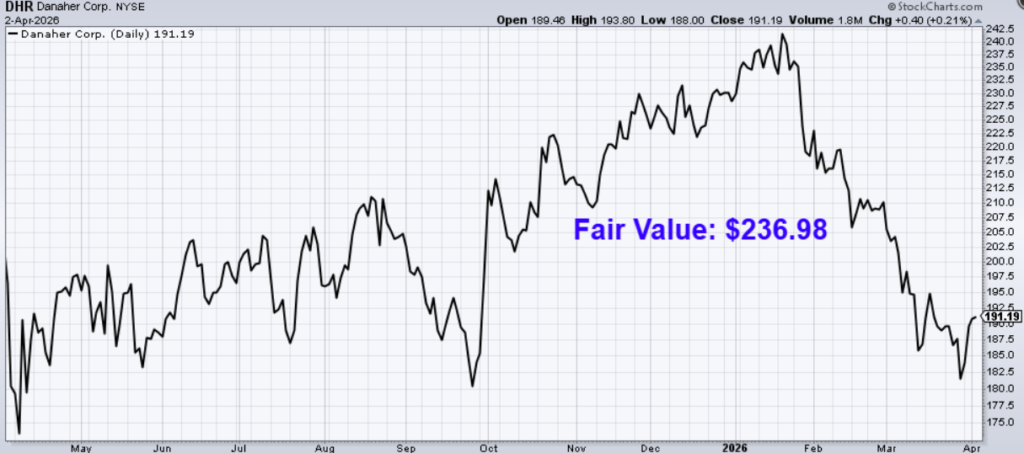 Bottom line: Danaher Corp. (DHR) is an elite specialist in the healthcare R&D space. It’s been a phenomenal performer over the last 40 years, and it appears primed to hit a new gear after a post-pandemic funk. With a market-like yield, double-digit dividend growth, a very low payout ratio, nearly 15 consecutive years of dividend increases, and the potential that shares are 20% undervalued, this looks like a great way to play healthcare for long-term dividend growth investors who favor high-quality compounders.
-Jason Fieber
Note from D&I: How safe is DHR‘s dividend? We ran the stock through Simply Safe Dividends, and as we go to press, its Dividend Safety Score is 80. Dividend Safety Scores range from 0 to 100. A score of 50 is average, 75 or higher is excellent, and 25 or lower is weak. With this in mind, DHR’s dividend appears Safe with an unlikely risk of being cut. Learn more about Dividend Safety Scores here.

P.S. If you’d like access to my entire six-figure dividend growth stock portfolio, as well as stock trades I make with my own money, I’ve made all of that available exclusively through Patreon.
Source: Dividends & Income
Disclosure: I have no position in DHR.
