

ARK Innovation’s Cathie Wood developed something of a cult following several years ago after her funds delivered eye-popping returns that had investors hanging on her every move. Although drawn to her bold predictions on disruptive technologies like AI, genomics, and fintech,, her performance has been uneven lately, soaring during bull markets, but struggling amid economic uncertainty.
Still, Wood is respected for her unwavering long-term vision, unafraid to place massive bets on companies she sees as future winners. However, yesterday’s $33.5 million purchase of Robinhood Markets (HOOD) has investors wondering if they should buy, too.
Crypto Weakness Weighs Heavy on HOOD
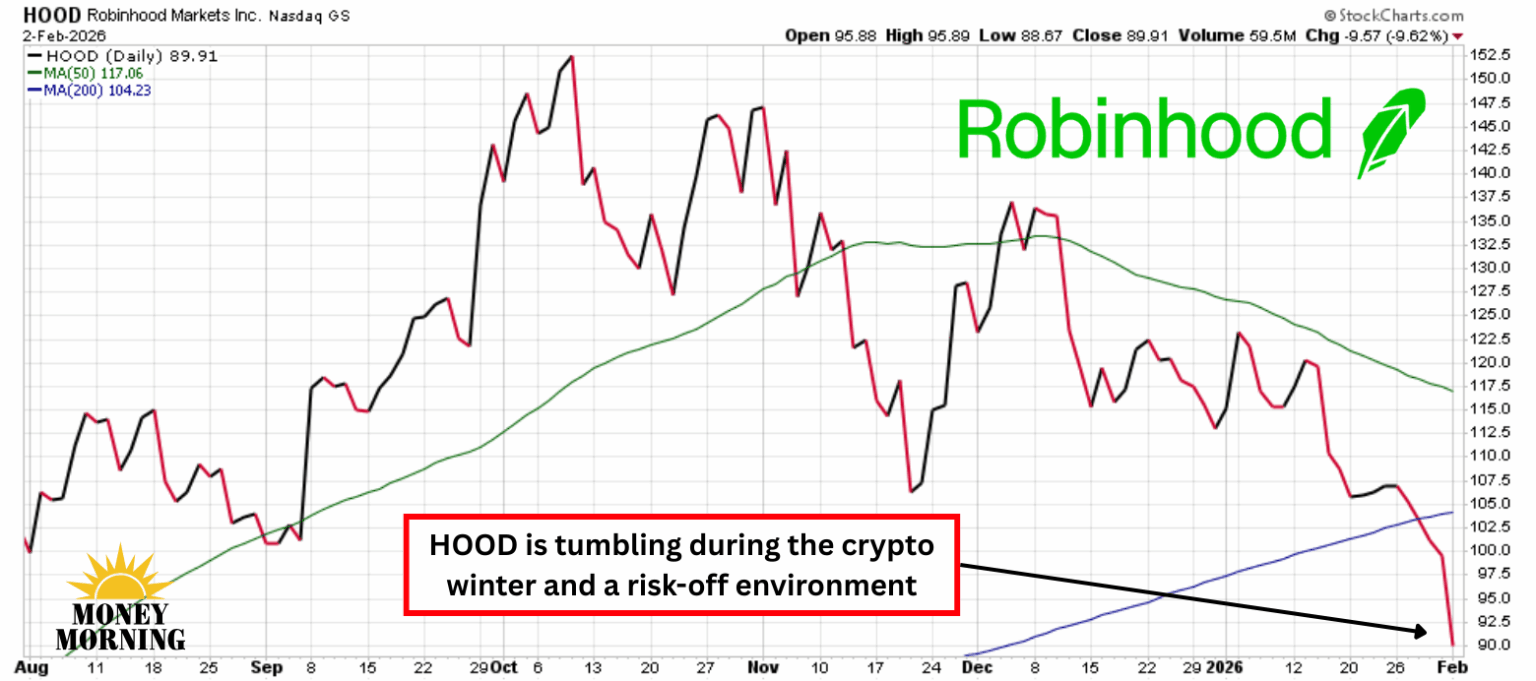
HOOD has taken a beating in 2026, down 20% year-to-date following a sharp 10% drop yesterday on ongoing weakness in the cryptocurrency markets. Bitcoin (BTC) has slumped 10% this year, dragging down platforms exposed to crypto trading.
While Robinhood is primarily known as a commission-free brokerage for stocks, its crypto offerings have become a significant revenue driver. The company allows seamless trading of popular coins like Bitcoin, Ethereum (ETH), and Dogecoin (DOGE), attracting a younger, tech-savvy user base. In fact, a higher proportion of Robinhood’s customers engage in crypto trades compared to traditional assets – recent earnings reports show crypto contributing around 20% of transaction-based revenues.
This exposure has been a double-edged sword: It fueled explosive growth during the 2021-2022 bull run but now amplifies downside pressure as investors flee volatile assets.
Robinhood’s business model thrives in high-volume, speculative environments. The platform democratized access to trading, drawing in millions during the pandemic with features like fractional shares and easy app-based interfaces. But as markets shift toward risk-off sentiment trading volumes have cooled causing Robinhood’s average revenue per user dipped 8% last quarter.
 Risky Bets and Meme Stock Legacy Heighten Vulnerability
Robinhood’s user demographics exacerbate these challenges. The brokerage caters to retail investors who favor high-risk strategies, such as options trading and leveraged bets. During the 2021 meme stock frenzy, Robinhood was ground zero, with its platform facilitating the viral trades that pitted small investors against hedge funds. While that episode boosted user growth to over 20 million, it also highlighted the company’s sensitivity to market whims.
In today’s environment, where the Federal Reserve’s hawkish stance is curbing speculation, these riskier trades are drying up. Options volume on Robinhood fell 12% year-over-year as cautious investors opt for safer havens like bonds or blue-chip stocks. Competitors like Charles Schwab (SCHW) or Fidelity, with more diversified portfolios including wealth management services, are faring better. Robinhood’s heavy reliance on transaction fees – over 70% of revenue – means it feels the pain more acutely during downturns.
Yet, not all is doom and gloom. The company has expanded into retirement accounts, credit cards, and even a premium subscription tier, aiming to build stickier revenue streams. Net deposits remain positive, signaling user loyalty despite the turbulence.
Bottom Line
This isn’t Cathie Wood’s first buy of HOOD – she owns $371 million worth in total, making HOOD her 10th-largest holding. For risk-tolerant investors with a long horizon, it’s still appealing: Revenue has grown consistently at 25% annually, and the firm turned profitable last year amid cost controls.
A severe economic downturn could sink the broader market and HOOD in the short term. But over the long haul, as fintech adoption rises and crypto matures, Robinhood should rebound, making this a buy-the-dip opportunity – just don’t bet the farm.
— Rich Duprey
Rumors are spreading quickly... Elon is gearing up to buy a tiny, publicly traded company. Why? Because it holds the exclusive rights to a $16 trillion MOTHERLODE of the exact materials his empire runs on... rare metals like cobalt, manganese and lithium. On January 1st, a new Pentagon rule cuts off his Chinese supply. Today, it's a $5 stock... but once Elon makes his move, it could soar to $50 within 6 months. Click here for the full story.
Source: Money Morning
