

Visa (V) is truly the Rocky Balboa of dividend stocks.
I know. I’m dating myself with that reference. But I can’t help it: Every time Visa takes a beating—and the mainstream crowd counts it out—it comes roaring back.
Take a look at this long-term chart. Every single dip was a buying opportunity—including this latest one:
Visa Gets Clobbered and Gets Back Up. Every Time
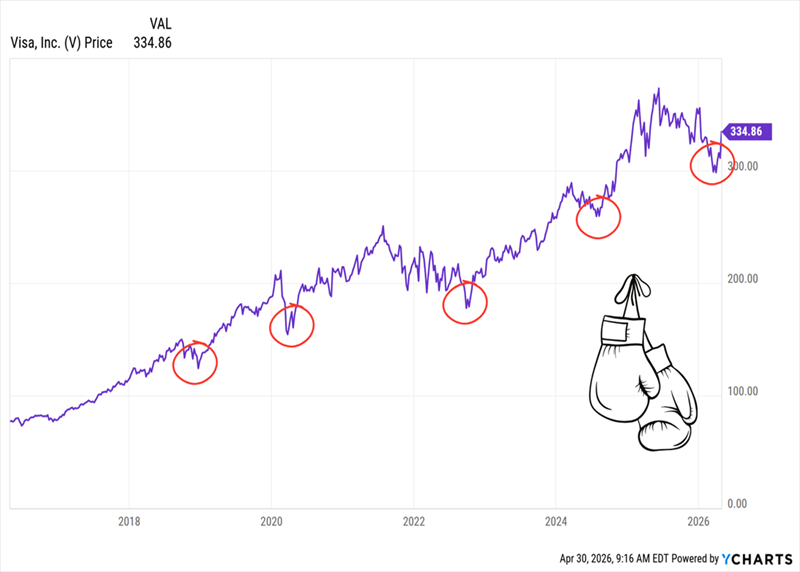 Its latest bounce—a 9% roll higher (see the right side of the chart above) during trading on April 29—came just last week, when the company reported earnings. But despite that rise, we haven’t missed our shot here. As we’ll get into momentarily, “Big V’s” next bounce is only beginning.
Visa—a holding of my Hidden Yields service—also gets no respect on the dividend front. With a current yield of just 0.8%, it doesn’t find itself on the radar of many income investors. That’s their loss, because this stock has two other “hidden” yields that are much higher.
Hidden Yield #1: A 3.5% (and Counting) Yield on Cost
The first one ties back to its strong dividend growth: Last October, management hiked the payout a full 13.6%. That followed a 13.5% hike the year before. And I expect this October’s raise to be even bigger, given recent strong results and the real results the company’s AI efforts are delivering (more on those below).
Add those accelerating hikes together and you get a yield on cost—or yield on your original buy—that grows fast. Anyone who bought a decade ago, for example, is yielding a tidy 3.5% on an investment made back then. That’s nearly 5X today’s current yield.
And the bigger the dividend hike, the more investors respond by bidding up the stock in tandem. I call this effect the Dividend Magnet, which you can clearly see in the case of Visa over the last decade:
Visa’s “Dividend Magnet” in Action
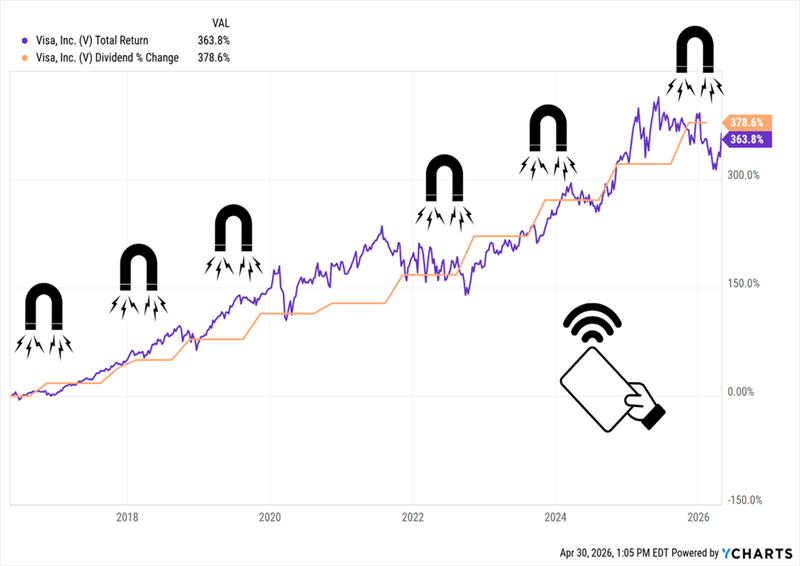 That’s another reason why we want to buy now, ahead of October’s likely hike: so we can start building on V’s 0.8% current yield before the year is out—and start profiting from “dividend-powered” share-price growth, too.
And the story gets better from there.
Hidden Yield #2: A “Buyback-Powered” 4.2% Shareholder Yield
Last week, we talked about shareholder yield, which is my favorite way to measure how much a stock really “pays” us, through both dividends and buybacks.
It’s a better measure than current yield. And for stocks that put an emphasis on buybacks, like our friend Visa, it’s a real difference-maker.
Here’s why: Over the last 12 months, Visa spent $4.9 billion on dividends, but a whopping $21.3 billion on buybacks, with no shares issued. Add those dividends and buybacks together ($26.2 billion) and divide by market cap ($629.1 billion) and you get a shareholder yield of 4.2% right now.
And the more the payout, and buybacks, grow, the higher that number gets on a buy made today.
Sure, we all love dividends, but Visa’s buyback focus makes sense here, as the stock has sunk in the last six months, giving management a nice window to buy at a discount.
And they have.
Visa Bargain Hunts Itself in Real Time
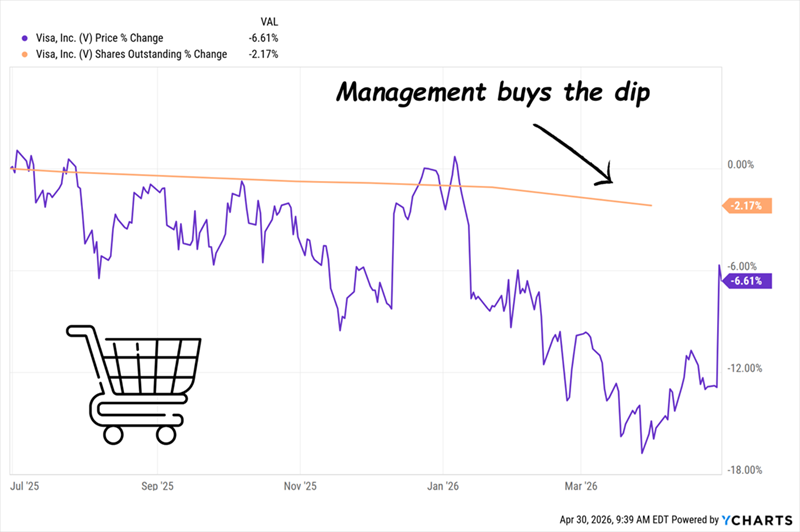 The cool thing about buybacks is that we can see management increasing them—or cutting the number of shares outstanding, in other words—in (almost) real time. And here we can clearly see that V bought back more shares as their price fell this year.
That’s smart cash management, as the C-suite knows (and we do, too) that the selloff in V shares has been overdone, based on fears that AI will let consumers transact directly with sellers, bypassing Visa’s network.
But that ignores two things: Visa’s own AI innovation and just how established its network is. In its latest quarter, the company handled 66 billion transactions—and that number was up 9% from a year ago. Visa, of course, collects a “toll” from each one.
As for AI, Visa is leveraging the tech in lots of different ways. For one, it’s working to allow autonomous AI agents to make purchases on behalf of users, and has built tools for this that developers can plug right into their models.
It’s also using AI to fight fraud, with CEO Ryan McInerney saying in the latest earnings call that the company’s efforts are catching up to five times more fraud, measured in dollar value.
These moves are still in early days, but they clearly show that management is ahead of the wave here, not about to be swamped by it.
Stablecoins Add to “Big V’s” AI Moves
Beyond that, Visa is benefiting from the growth of “stablecoins.” Unlike other cryptocurrencies, stablecoins are pegged to the US dollar. That makes them ideal for international transactions, as they get around pokey, high-fee wire transfers.
By moving into stablecoins, Visa is essentially building the bridge between traditional payments and regulated stablecoin settlements in USD.
This is behind-the-scenes, bank-to-bank money movement (subject to Visa’s fee, of course!) that happens after you tap your card.
This business is growing quickly. As of March 31, Visa’s monthly stablecoin settlement volume had reached a $7-billion annual run rate, up 50% from the previous quarter. In other words, the “digital dollar” pipes are live, and they’re scaling fast. As more banks and fintechs issue stablecoins, this number will only grow.
A Safe Dividend Primed for Another Big Hike
Let’s wrap with another look at that dividend, and why I see a potential hike topping last October’s 13.6% monster.
In the latest quarter, Visa’s revenue popped 17%. Adjusted EPS jumped 20%. These are huge numbers and proof positive that Visa’s moves to stay ahead of AI’s advance are paying off.
The balance sheet continues to be strong, with just $9.4 billion of debt, net of cash and short-term investments. That’s a pittance for a $629-billion company like this one. And with the payout occupying just 23% of the last 12 months of free cash flow, Visa could double the payout now and still be under my 50% “safe zone.”
The bottom line? We’re not too late to buy the dip here. Let’s move in now, well before management announces that next payout hike in October.
— Brett Owens
Visa’s “Dividend Magnet” Always Prevails. Here Are 5 More Winners [sponsor]
Visa is the perfect example of what I call a “Dividend Magnet” stock, which is why it’s a Hidden Yields holding.
As we saw above, its share price always tracks its dividend higher. And when it falls behind, that’s the time to buy. We’ve got just such a setup now:
Big V’s Share Price Lags Its Payout (for Now)
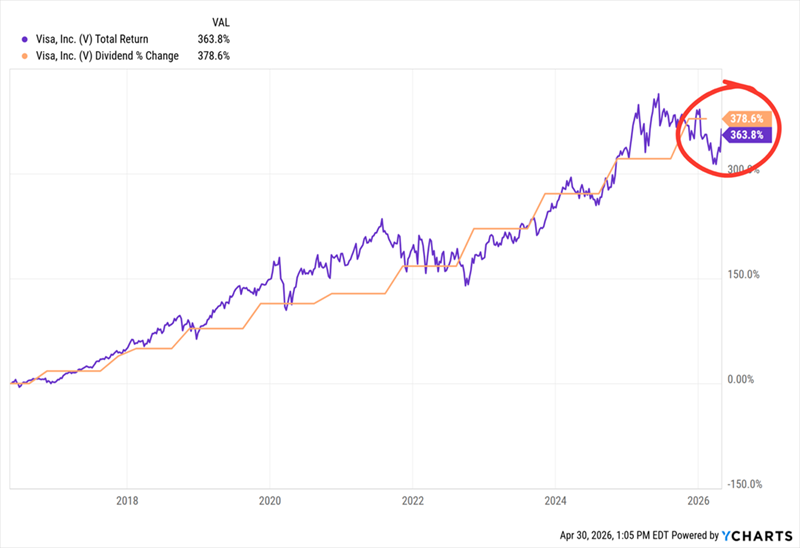 I’ve seen this “Dividend Magnet” pattern play out with other stocks over and over again. To make the most of it, we want dividend payers whose payouts are not only growing but accelerating (as Visa’s definitely is!).
After all, the bigger the hike, the more other investors notice—and the higher they bid up those share prices.
We want to be in before that happens—and I’m going to help you do that, with 5 stocks boasting some of the most powerful Dividend Magnets I’ve ever seen. And, critically, they have the financial strength to keep those payouts growing for many years to come.
Click here to learn more about these 5 Dividend Magnet stocks and claim a free Special Report revealing their names and tickers. The time to buy them is now, before they announce their next big payout hike.
Source: Contrarian Outlook
