
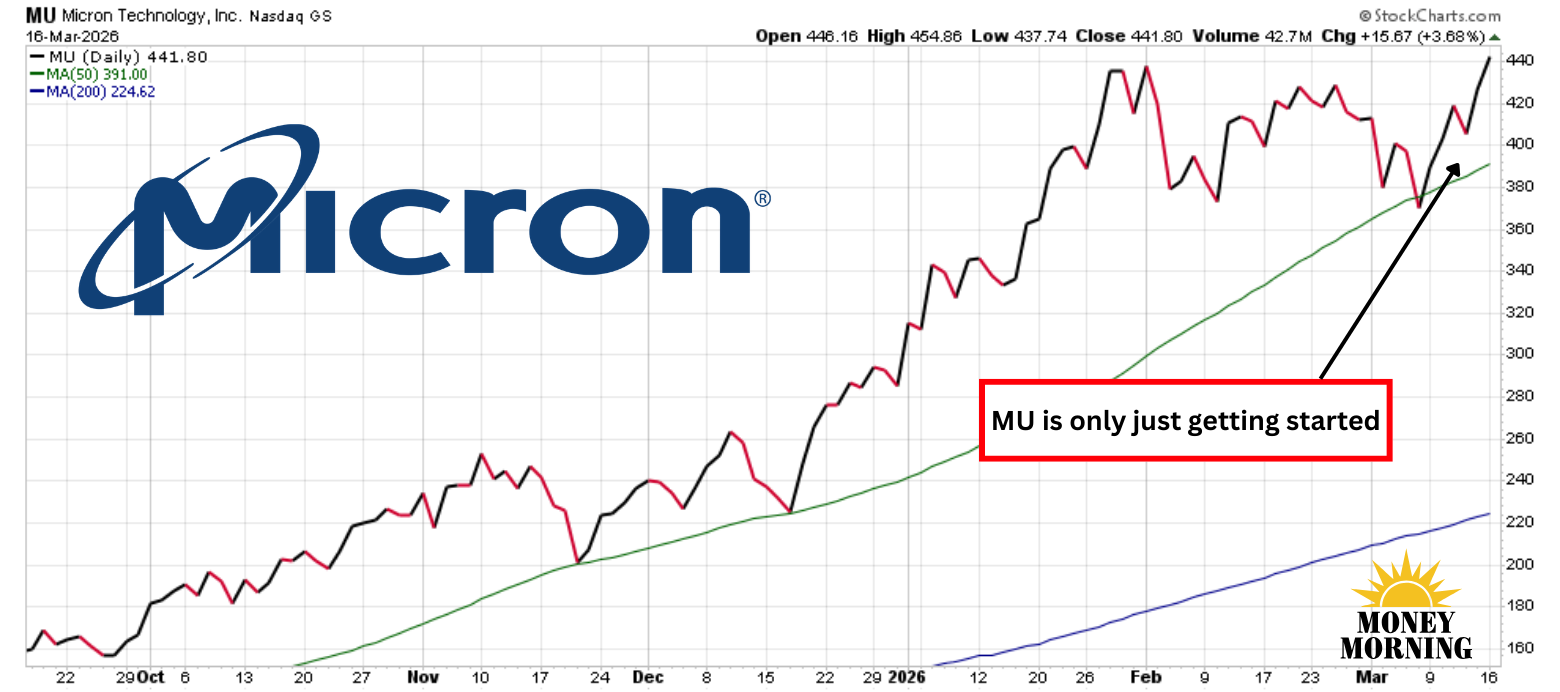
 Micron Technology (MU) has ridden the explosive wave of AI-driven demand for high-bandwidth memory (HBM) and DRAM over the past year, sending its stock price more than quadrupling from its 52-week lows. The surge reflects Micron’s rapid ramp in supplying critical memory solutions to the world’s leading AI accelerators, fueled by insatiable needs for faster, higher-capacity memory in data centers.
Yet MU is only just getting started. With fresh breakthroughs unveiled this week at Nvidia‘s (NVDA) GTC Technology Conference, the company has decisively unlocked its next massive growth phase, cementing its role as an indispensable partner in the accelerating AI infrastructure supercycle that analysts now project will run well into the future.
Micron Steals the Spotlight at GTC 2026
Appearing alongside Nvidia at its flagship conference, Micron announced it has launched high-volume production of its groundbreaking HBM4 memory – specifically the 36GB 12-high stack – optimized for Nvidia’s just-revealed next-generation Vera Rubin platform. Shipments began in Q1, delivering over 11 Gb/s pin speeds, more than 2.8 TB/s of bandwidth (a 2.3x improvement over HBM3E), and greater than 20% better power efficiency per bit.
Micron also highlighted industry-first high-volume production of its PCIe Gen6 SSD (the 9650) and 192GB SOCAMM2 modules, all tailored for Vera Rubin’s demanding AI workloads. As Micron EVP Sumit Sadana noted, “Our close collaboration with Nvidia ensures that compute and memory are designed to scale together from day one,” underscoring a deepening strategic partnership that positions Micron ahead of competitors in the race for next-gen AI memory leadership.
HBM: The Essential Fuel for AI Systems
High-bandwidth memory is the unsung hero of modern AI. Unlike traditional DRAM, HBM stacks multiple dies vertically beside GPUs, slashing latency while delivering the terabytes-per-second throughput needed to feed massive neural networks during training and inference. Without it, even the most powerful chips stall under the weight of trillion-parameter models. This reality directly ties into Nvidia’s newly forecasted $1 trillion revenue opportunity for AI chips through 2027 – more than doubling its prior $500 billion outlook.
As Nvidia’s Vera Rubin platform and future generations scale AI training clusters into the millions of GPUs, Micron’s HBM4 supply will capture a growing slice of that trillion-dollar pie, translating into sustained, multi-year revenue acceleration, margin expansion, and potentially record profitability for MU.
Bottom Line
Despite its dramatic run-up, Micron still trades at a remarkably low 7x forward P/E – among the cheapest valuations in the entire semiconductor sector. Its PEG ratio is minuscule when measured against Wall Street’s consensus forecast of an 84% compound annual EPS growth rate over the next five years.
Following this week’s Vera Rubin reveal and Micron’s production milestone announcements, analysts have significantly boosted price targets across the board, with several now calling for 50%+ upside. The message is clear: the AI memory supercycle is just beginning, and MU remains one of the most compelling, asymmetrically positioned ways to play it.
— Rich Duprey
$3 billion+ in operating income. Market cap under $8 billion. 15% revenue growth. 20% dividend growth. No other American stock but ONE can meet these criteria... here's why Donald Trump publicly backed it on Truth Social. See His Breakdown of the Seven Stocks You Should Own Here.
Source: Money Morning

